During the “Lavender Scare,” D.C. Became a Center of Gay Rights Activism
Today’s U.S. history textbooks are sure to mention the “Second Red Scare,” the 1950s fear campaign spearheaded by Senator Joseph McCarthy that ousted suspected communists from the government. But Americans are probably less familiar with a parallel wave of persecution known as the “Lavender Scare” that forced thousands of gay and lesbian federal employees from their jobs in the late 1940s through the 1960s.
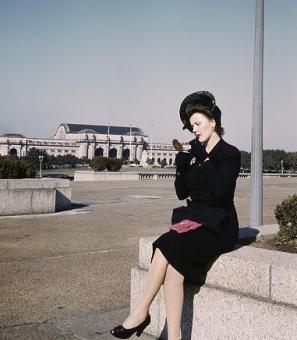
With homophobia already deeply entrenched in American society, homosexuality became linked to communism during the Cold War as McCarthy and other officials argued that being gay presented a “security risk” if foreign governments blackmailed individuals over their sexuality. 1 As the home to many of these targeted federal workers, Washington, D.C. became a center of resistance to the anti-gay purges and corresponding moral panic.
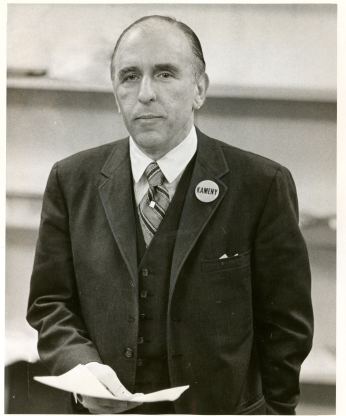
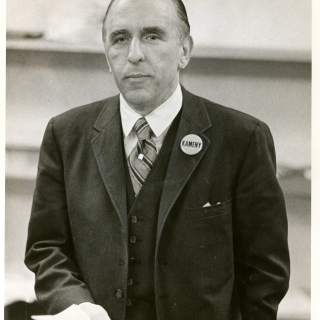
Leading this initial pushback was the Mattachine Society of Washington (MSW), the local chapter of one of the nation’s oldest LGBTQ+ activist groups, originally organized in California in 1950. 2 The MSW was co-founded in November 1961 by Jack Nichols and Dr. Frank Kameny, the latter of whom had lost his job with the Army Map Service several years earlier due to his suspected homosexuality. 3
Despite being a Harvard-educated astronomer and World War II combat veteran, Kameny would face widespread bigotry on the homefront as anti-gay policies were codified. Amid the growing Lavender Scare, the Hoey committee released a congressional report in 1950 claiming that homosexuals constituted “security risks in positions of public trust.” 4 Three years later, citing the “best interests of the national security,” President Dwight Eisenhower signed Executive Order 10450, which barred individuals with “sexual perversion[s]” from serving in the government or as government contractors. 5
Historians estimate that between 5,000 and tens of thousands of gay workers lost their jobs during the Scare, with untold more not bothering to apply for positions or promotions for fear of being interrogated. 6 Unlike the highly visible hearings of the Red Scare, much of the Lavender Scare occurred behind closed doors and its victims often avoided publicizing their experiences for fear of further retribution.
Kameny decided to take a different approach. Unable to find work and living on unemployment insurance, he challenged his dismissal and in 1960 wrote his own pro se petition to the Supreme Court. 7 While the Supreme Court ultimately declined to hear the case, Kameny (who possessed no legal training himself) had made history by bringing forward the first known civil rights claim based on sexual orientation. 8
While officials cast homosexuality as a perverse and morally deviant act, Kameny asserted in his filings that “homosexuality, whether by mere inclination or by overt act, is not only not immoral, but … for those choosing voluntarily to engage in homosexual acts, such acts are moral in a real and positive sense, and are good, right, and desirable, socially and personally.” 9 He would carry forward this then-radical stance to the Mattachine Society of Washington, which he co-founded soon after.
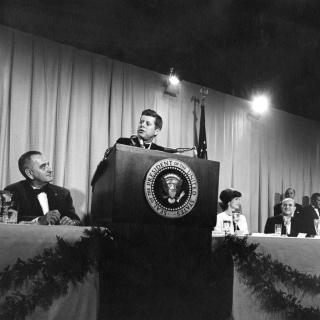
The MSW quickly distinguished itself from existing gay rights organizations for its militancy and a more direct approach to activism. The group began a letter-writing campaign to public officials, including President John F. Kennedy and Vice President Lyndon Johnson. 10 It even mailed copies of its newsletter, the Gazette, to FBI Director J. Edgar Hoover, whose service had been conducting surveillance of the organization. 11
An enraged Hoover apparently demanded his name be removed from the mailing list and sent agents to meet with Mattachine representatives. According to the Rainbow History Project, a nonprofit dedicated to promoting D.C.’s LGBTQ+ history, the MSW invited Hoover to “attend a homosexual conference taking place in D.C.” in return and said they’d stop sending the Gazette if the FBI destroyed all of its MSW files. 12 The FBI ignored the offer and the deliveries continued.
The MSW faced active resistance from local as well as federal authorities. In August 1962 the society was granted a license to ask for donations under D.C.’s Charitable Solicitations Act. 13 C.T. Nottingham, the city’s superintendent of licenses and permits, told The Evening Star that “his office had no authority to deny a solicitation permit to any organization whose representatives answer all questions on the permit application form.” 14 But Nottingham added that he had informed the MSW that if the group solicited “as much as one dollar,” he would order them to open their books for examination and move to have their permit revoked if they didn’t comply. 15
The mere issuing of a fundraising permit to a local gay rights group set off a firestorm of protest from the House of Representatives’ District of Columbia Subcommittee, which had widespread authority over city affairs prior to the Home Rule Act of 1973. 16 Subcommittee Chairman John Dowdy, a Texas Democrat, introduced a bill in the summer of 1963 that would revoke the MSW’s license and prevent city commissioners from issuing solicitation permits unless the “solicitation which would be authorized by such certificate will benefit or assist in promoting the health, welfare and morals of the District…” 17
“The bill is rather remarkable in the amount of unconstitutionality packed into two short paragraphs,” American Civil Liberties Union attorney Monroe H. Freedman said of Dowdy’s proposal at an August 9, 1963 hearing. 18 In a letter to the subcommittee, District Commissioners made it clear they opposed the bill too, but solely on constitutional grounds and the fact it would impose “a heavy and difficult burden” on the city to scrutinize so many applications. 19 The commissioners stressed their position “is not to be construed as approving homosexual practices.” 20
Kameny appeared on behalf of the MSW at the hearing and repeatedly refused to turn over a list of the society’s members when pressed. 21 Representative Frank J. Horton of New York questioned Kameny on the MSW’s goals and openly criticized their efforts to “erase from the criminal statutes any ban on the committing of homosexual acts in private between consenting adults.” 22
Dowdy, meanwhile, “quoted from the Bible passages condemning homosexual acts,” to which Kameny responded that he thought it was “‘grossly improper’ for a member of Congress to use arguments based on religion,” according to reports. 23 Kameny also declined to say whether the other officers’ names listed on their fundraising application were pseudonyms—leading the Department of Licenses and Inspections to schedule another hearing and propose revoking the license on the grounds it contained false names. 24
By October 1963, the MSW had surrendered its permit since it turned out that organizations receiving less than $1,500 yearly in donations were exempt from the solicitations law. 25 But the city wasn’t willing to let things slide just yet—the District Commissioners proposed an amendment to eliminate the $1,500 exemption, thereby requiring the MSW to apply for a new permit. 26 The amendment was submitted for “no other apparent reason than to harass the Mattachine Society,” an exasperated ACLU representative said. 27
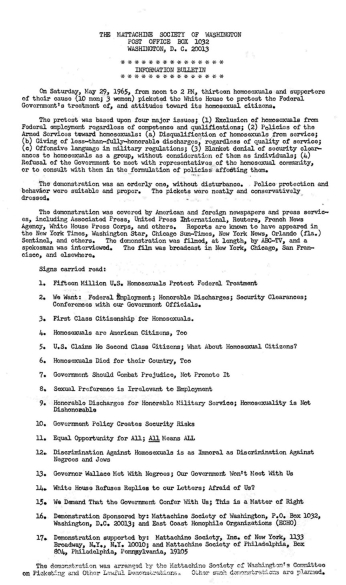
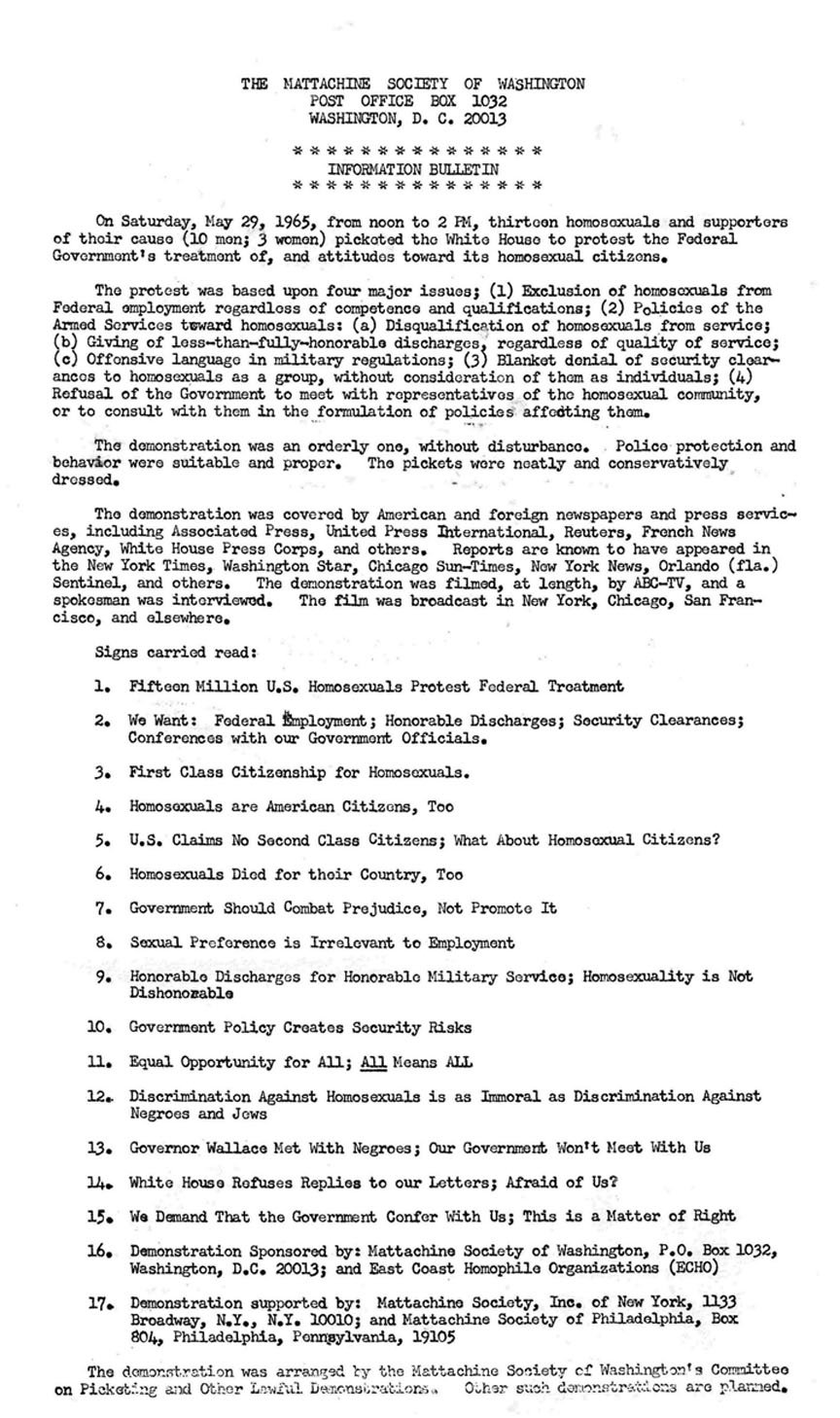
In spite of the continued harassment, the MSW decided to expand its activities yet again. On April 17, 1965, Kameny, D.C.-area lesbian activist Lilli Vincenz, and a handful of MSW members held the first organized picket for gay rights in front of the White House in Lafayette Park. 28 Dressed in business attire, the picketers walked in a circle in silence for an hour and held aloft posters with their demands, including “Homosexual Citizens Want to Serve Their Country Too!” and “Sexual Preference is Irrelevant to Federal Employment!” 29
No participants were injured or arrested and an emboldened MSW decided to lead similar pickets throughout the year, including others at the White House on May 29 and October 23, at the Pentagon on July 31, and the State Department on August 28. 30
Kameny explained their aims to President Johnson in a letter the day of the October picket: “A group of homosexual American citizens, and those supporting their cause, is picketing the White House, today, in lawful, dignified, and orderly protest—in the best American tradition—against the treatment being meted out to fifteen million homosexual American citizens by their government—treatment which constantly makes of them second-class citizens, at best.” 31
Over the next four years, the MSW, along with the East Coast Homophile Organizations (ECHO), coordinated an annual July 4th “Reminder Day Picket” at Philadelphia’s Independence Hall as picketing grew in popularity. 32 Then, in June 1969, the Stonewall Uprising in New York brought unprecedented levels of visibility to the LGBTQ+ rights movement.
To commemorate the first anniversary of the riots, one of the first-ever pride marches, dubbed Christopher Street Liberation Day, was held on June 28, 1970. 33 Holding a sign with the slogan “Gay is Good,” which he coined, Kameny and the MSW joined more than 2,000 participants in the historic parade from Greenwich Village to Central Park. 34
Momentum was building and in 1975 the Civil Service Commission—today’s Office of Personnel Management—ended its ban on gays and lesbians in the federal workforce. 35 In 2009, OPM formally apologized to Kameny for his firing over 50 years earlier. 36 He died in 2011, aged 86, a year after witnessing President Barack Obama sign the repeal of the military’s “Don’t Ask, Don’t Tell” policy. 37
Regarding that first Christopher Street Liberation Day in 1970, Kameny reflected that “it was a direct lineal descendant of our ten frightened little people in front of the White House, almost exactly five years before.” 38
Footnotes
- 1
David K. Johnson, The Lavender Scare (Chicago and London: The University of Chicago Press, 2004).
- 2
“Los Angeles, 1950: The Mattachine Society,” Rainbow History Project Digital Collections.
- 3
“Today in History - April 17: Frank Kameny Leads White House Picket,” Library of Congress Digital Collections.
- 4
Judith Atkins, “‘These People Are Frightened to Death:’ Congressional Investigations and the Lavender Scare,” Prologue Magazine, Vol. 48, No. 2 (Summer 2016).
- 5
U.S. President. Executive Order. “Security Requirements for Government Employment, Executive Order 10450 of April 27, 1953.” Federal Register 2489, 3 CFR, 1949-1953 Comp., p. 936.
- 6
Atkins.
- 7
Hannah Schuster, “Fired for Being Gay, Frank Kameny Spent the Rest of His Life Fighting Back,” WETA, Boundary Stones, June 24, 2019.
- 8
“Today in History - April 17: Frank Kameny Leads White House Picket,” Library of Congress Digital Collections.
- 9
Franklin Edward Kameny v. William Brucker, Secretary of the Army, et al., Petition for a Writ of Certiorari, no. 676, U.S. Supreme Court, October 1960 term.
- 10
“The Mattachine Society of Washington,” Rainbow History Project Digital Collections.
- 11
“The Mattachine Society of Washington,” Rainbow History Project Digital Collections.
- 12
“The Mattachine Society of Washington,” Rainbow History Project Digital Collections.
- 13
“Group Aiding Deviates Issued Charity License,” The Sunday Star (Washington, D.C.), September 16, 1962.
- 14
“Group Aiding Deviates Issued Charity License,” The Sunday Star (Washington, D.C.), September 16, 1962.
- 15
“Group Aiding Deviates Issued Charity License,” The Sunday Star (Washington, D.C.), September 16, 1962.
- 16
“Mattachine Hearings Set,” The Evening Star (Washington, D.C.), August 4, 1963.
- 17
“D.C. Fights Bill Cutting Help for Homosexuals,” The Evening Star (Washington, D.C.), August 8, 1963.
- 18
“Bill on Homosexuals Held Unconstitutional,” The Evening Star (Washington, D.C.), August 10, 1963.
- 19
“D.C. Fights Bill Cutting Help for Homosexuals,” The Evening Star (Washington, D.C.), August 8, 1963.
- 20
“D.C. Fights Bill Cutting Help for Homosexuals,” The Evening Star (Washington, D.C.), August 8, 1963.
- 21
“Bill on Homosexuals Held Unconstitutional,” The Evening Star (Washington, D.C.), August 10, 1963.
- 22
“Bill on Homosexuals Held Unconstitutional,” The Evening Star (Washington, D.C.), August 10, 1963.
- 23
“Society Refuses List to District Committee,” The Evening Star (Washington, D.C.), August 9, 1963.
- 24
“D.C. Hearing To Challenge Homosexuals,” The Evening Star (Washington, D.C.), September 18, 1963.
- 25
“Mattachine Unit Loses Its Permit to Solicit Funds,” The Evening Star (Washington, D.C.), October 4, 1963.
- 26
“Mattachine Society Harassment Charged,” The Evening Star (Washington, D.C.), November 9, 1963.
- 27
“Mattachine Society Harassment Charged,” The Evening Star (Washington, D.C.), November 9, 1963.
- 28
“Today in History - April 17: Frank Kameny Leads White House Picket,” Library of Congress Digital Collections.
- 29
Sarah Fling, “LGBTQ+ Protests in Lafayette Square,” The White House Historical Association, June 18, 2020.
- 30
“Today in History - April 17: Frank Kameny Leads White House Picket,” Library of Congress Digital Collections.
- 31
Frank Kameny, “Letter from Frank Kameny to President Lyndon B. Johnson,” The Kameny Papers, October 23, 1965.
- 32
“Today in History - April 17: Frank Kameny Leads White House Picket,” Library of Congress Digital Collections.
- 33
“Today in History - June 28: The Stonewall Uprising of 1969,” Library of Congress Digital Collections.
- 34
“Today in History - April 17: Frank Kameny Leads White House Picket,” Library of Congress Digital Collections; “Christopher Street Liberation Day 1970,” 1969 The Year of Gay Liberation, New York Public Library Exhibitions.
- 35
“LGBTQIA+ Federal Employment in the Records at the National Archives,” National Archives.
- 36
Hannah Schuster, “Fired for Being Gay, Frank Kameny Spent the Rest of His Life Fighting Back,” WETA, Boundary Stones, June 24, 2019.
- 37
Stephanie Hinnershitz, “Frank Kameny: WWII Veteran, Patriot, and LGBTQ+ Activist,” The National WWII Museum, June 26, 2024.
- 38
“Today in History - April 17: Frank Kameny Leads White House Picket,” Library of Congress Digital Collections.
![Sketch of the mythical fuan by Pearson Scott Foresman. [Source: Wikipedia]](/sites/default/files/styles/crop_320x320/public/2023-10/Goatman_Wikipedia_Faun_2_%28PSF%29.png?h=64a074ff&itok=C9Qh-PE1)