U-1105 “Black Panther”: How a Nazi Submarine Ended up in the Potomac River
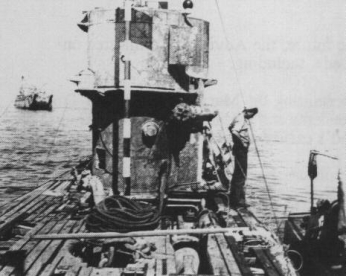
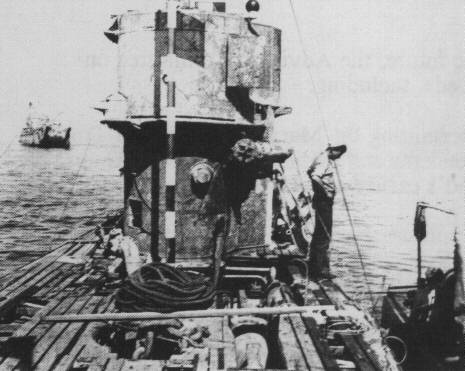
Just 80 miles south of Washington, D.C., in the brackish waters of the Potomac River, sits one of the most peculiar shipwrecks of World War II. Resting on the river bottom about a mile offshore from Piney Point, Maryland, partially obscured by silt, is the U-1105, a one-of-its-kind German U-boat known in its day as “Black Panther” that stalked Allied ships in the final days of the war.
U-1105 had several unique features that would revolutionize later submarine designs. It was coated in a synthetic black rubber skin that helped counter enemy sonar systems—and inspired the ship’s nickname. 1 It also had a Schnorchel—or snorkel—device that allowed U-1105 to take in fresh air, charge batteries, and run on diesel motors while remaining submerged almost indefinitely. 2
So what is an experimental Nazi sub doing in the Potomac? The short answer is the U.S. Navy sank it there in 1949 as part of testing carried out on captured war prizes. The U-1105’s first and only war patrol was in Irish, not Maryland, waters in April 1945, so a German periscope never set its sights on the Washington Monument. But the story of U-1105 is key to understanding the evolution of submarine warfare during the Battle of the Atlantic, which pitted Germany’s U-boat fleet against Allied merchant convoys and their escorts.
Even though U-1105 didn’t venture to America until after the war, plenty of other U-boats went before it. Following Germany’s declaration of war on the U.S. in December 1941, Admiral Karl Dönitz dispatched submarines to prowl the East Coast as part of Operation Drumbeat. 3 The Americans were caught unprepared and failed to protect lone cargo ships and tankers, some of which were silhouetted by lights of cities at night and became easy prey.
In the first three months of 1942 alone, U-boats sank over 100 ships off the East Coast and in the Caribbean Sea and the Gulf of Mexico, leading gleeful German commanders to dub the period “American shooting season” or the “Second Happy Time,” following successes against British shipping earlier in the war. 4 One of the most audacious phases of the operation came in May 1942, when five U-boats were diverted for special missions to mine U.S. ports and land Nazi saboteurs on Long Island and in northern Florida. 5
One of these vessels, U-701, was assigned to mine the Chesapeake Bay and arrived off the bay’s entrance on June 12, 1942. 6 Within half an hour, the U-boat laid 15 mines in 36 feet of water directly in the bay’s shipping channel. 7 Although U-701 was later sunk off of Cape Hatteras, the minefield proved productive, sinking two ships and heavily damaging three more. 8
Orders issued in June 1943 to another U-boat, U-230, also called for the approach routes to Norfolk and the Chesapeake Bay “to be fouled with mines inside the 25-meter line,” instructing the commanding officer “to make every effort to lay the mines as far inshore as possible.” 9 While U-230 and its companion U-566 complied, these minefields failed to achieve any sinkings. 10
American officials tried to downplay the extent of the U-boat threat and didn’t publicly reveal the danger posed by German mines in the Chesapeake until the war’s end. U-boats “planted mines so effectively,” according to a 1945 Associated Press report, that the entrance to the Chesapeake had to be closed to ship traffic for several days in June and September 1942 as minesweepers cleared the area. 11
Despite inflicting tremendous losses, by the middle of 1942 the “Second Happy Time” was drawing to a close. Land-based American air cover, along with continued advancements in Allied radar and sonar technologies, including the Anti-Submarine Detection Investigation Committee (ASDIC) system, caused U-boat casualties to spiral. 12 The Germans would need to develop their own technological edge to better detect ships while avoiding being detected as they shifted from wolfpack to “lone wolf” operations.
That’s how U-1105 came into being. A modified Type VIIC submarine, U-1105 was built at the Nordseewerke Shipyard in Emden, Germany, and launched on April 20, 1944—Adolf Hitler’s 55th birthday. 13 It was one of less than 10 U-boats outfitted with a special skin made up of rubber tiles perforated with different sized holes, designed to absorb the “pings” emitted by sonar from Allied ships. 14
This coating, an early form of stealth technology, was codenamed Alberich, after the magical invisibility helmet worn by a dwarf in the Wagner opera Der Ring des Nibelungen. 15 Studies found that the top-secret Alberich could reduce ASDIC sonar returns by at least 20%. 16
Aside from Alberich, U-1105’s advanced tech also included its Schnorchel, a new passive sonar array for detecting surface vessels (that could even hear sounds over the horizon), and a high-frequency burst transmission system for communicating that was nearly impossible to intercept. 17 It would become the only known U-boat to make a war patrol carrying all four of these technologies. 18
U-1105’s “Black Panther” nickname had multiple origins, all stemming from “Schwarz,” the German word for black. For one, Alberich rendered the ship black, rather than a U-boat’s typical gray coloring. While training on the Baltic Sea, members of the crew also grew fond of the German jazz song “Schwarzer Panther.” Lastly, U-1105’s commander was coincidentally named Hans-Joachim Schwarz (although the opera-loving Schwarz apparently hated jazz and banned the playing of the song on board). 19
When time came to pick the U-boat’s emblem, the crew proposed a black panther sitting atop a globe, which was eventually painted on U-1105’s conning tower. 20 “So we had a name, an emblem, and even a theme song!” one crew member later remarked. 21
U-1105 embarked on its sole war patrol on April 12, 1945, targeting Allied convoy routes in the Western Approaches off of Ireland. 22 On April 27 the U-boat detected three British destroyers that were part of the 21st Escort Group and unleashed two acoustic torpedoes before diving to escape a possible counterattack. 23 At least one of the torpedoes struck the HMS Redmill about 50 seconds later, killing 32 crewmen. 24
U-1105 took on too much ballast during its descent and came to a rest on the seafloor at 570 feet, where it remained for 31 hours before finally resurfacing. 25 Thanks to its Alberich, the U-boat avoided detection for the next few days before receiving orders from Admiral Dönitz to cease hostilities on May 4. 26 The crew ironically surrendered to the 21st Escort Group—the same group it had just attacked—and were escorted into Loch Eriboll, Scotland, before transferring to Lishally, Northern Ireland. 27
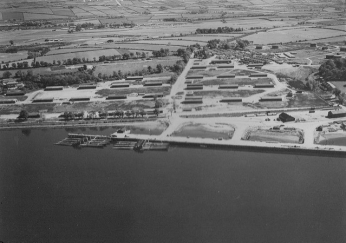
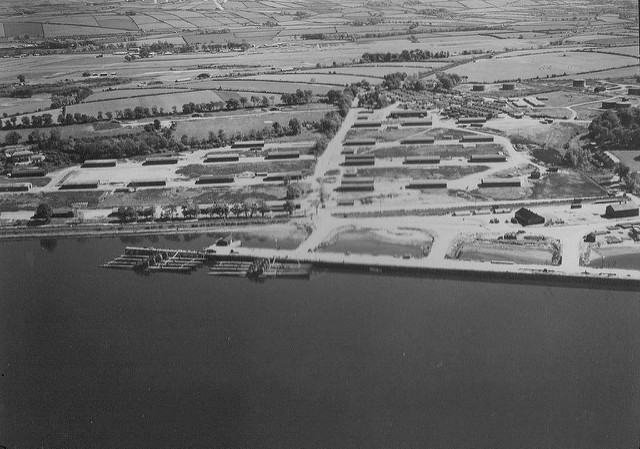
The end of the war sparked an immediate race between the Allies to get their hands on advanced Nazi weaponry—including U-1105. Freshly commissioned into the Royal Navy, the U-boat underwent extensive testing by the British between May and December of 1945. 28 However, to keep the sub away from Soviet naval officials—who had taken notice—the Royal Navy decided the Americans should take possession of the Black Panther. 29
In the winter of 1945-1946, U-1105 became the last World War II U-boat to cross the North Atlantic under its own power—barely. 30 During its two-week crossing the submarine sailed into a major storm and experienced 80-degree rolls that began to flood the vessel before its U.S. crew employed the Schnorchel at the behest of a Royal Navy engineer who had remained on board. 31 U-1105 miraculously arrived in Portsmouth, New Hampshire on January 2, 1946, after U.S. Navy authorities considered it lost following a 10-day radio outage. 32
Soon after its arrival, two nine-foot sections of Alberich were sliced away from the hull and sent to the Massachusetts Institute of Technology and the Naval Research Laboratory in Washington, D.C., for testing. 33 In January 1947 the sub was towed to the Naval Mine Warfare Test Station in Solomons, Maryland, and then to the Naval Gun Factory at Washington’s Navy Yard, where it remained for 18 months (so technically a U-boat has been within periscope range of the monuments). 34
In 1948 Navy ships towed U-1105 back towards the Chesapeake and the boat was sunk and raised multiple times over the next year as part of explosives and salvage tests (you can watch surviving footage of those tests here). 35 Finally, on September 19, 1949, U-1105 sank for a sixth and final time off of Piney Point after a 250-pound MK2 depth charge was detonated 30 feet below the keel. 36 She went down in less than a minute, landing upright in about 91 feet of water. 37
The wreck of the Black Panther remained largely forgotten for the next 36 years, until it was discovered on June 29, 1985, 38 by a team of sport divers led by Fredericksburg, Virginia resident Uwe Lovas. According to a 1994 Baltimore Sun article, Lovas—a computer technician and shipwreck enthusiast—realized that Navy records had erroneously transposed the boat’s longitude from 76 degrees to 67 degrees. 39 The divers kept their find secret for five years before introducing U-boat historian Henry Keatts to the site. 40
In 1995 U-1105 was officially designated as Maryland’s first historic shipwreck preserve. 41 The preserve is open to recreational divers, although a high level of training and experience is needed due to the site’s poor visibility and strong currents. Approximately 20 divers visit the wreck site annually, according to Troy Nowak, the State Underwater Archaeologist with the Maryland Historical Trust, and a mooring buoy marks its location between April and November. 42
“U-1105 is buried with only the superstructure surrounding its conning tower and a small portion of its deck and saddle tanks exposed and accessible to divers,” Nowak, who has personally visited the U-boat at least four times, said in an email. 43 “It is in an excellent state of preservation which can be attributed to the water chemistry of Potomac River and its location and depth which reduce erosive river forces.”
U-1105’s relatively late “rediscovery” and the difficulty of reaching it has also limited the kind of damage caused by collectors and overly curious visitors to other accessible U-boat wrecks, Nowak explained. 44 Non-divers can enjoy a recently expanded exhibit about U-1105 at the Piney Point Lighthouse Museum. 45
Despite its short service history, U-1105’s impact is still felt across the world’s navies today. Virtually all modern subs, including nuclear submarines, carry some type of a Schnorchel device. Their hulls are also sure to include a form of synthetic anti-acoustic coating—the modern-day successors of the Alberich tiles still visible on U-1105’s sunken superstructure in the Potomac.
Footnotes
- 1
“U-1105 Wreck Site (1949),” (Naval History and Heritage Command).
- 2
Aaron S. Hamilton et al., “The U-1105 ‘Black Panther’ (18ST636): 2021-2022 Maritime Archaeological Survey Report,” Battle of the Atlantic Research and Expedition Group, May 2023, 8.
- 3
“U-Boats Off the Virginia Coast,” (Virginia Places).
- 4
“Fighting U-Boats in American Waters,” National Museum of the United States Air Force; Melanie Damour, “The Search for Norlindo – The First World War II Casualty in the Gulf of Mexico,” NOAA Ocean Exploration, August 16, 2021.
- 5
“U-701,” NOAA Monitor National Marine Sanctuary.
- 6
“U-701,” NOAA Monitor National Marine Sanctuary.
- 7
“U-701,” NOAA Monitor National Marine Sanctuary.
- 8
“Nazi Mines Closed U.S. Ports Several Times in ’42 and ’43,” Associated Press in The Springfield Weekly Republican (Springfield, Massachusetts), June 21, 1945.
- 9
“Operations Order Norfolk for U 230”, U-Boat Archives.
- 10
Clay Blair, Hitler’s U-Boat War (Random House, 1996), 387.
- 11
“Nazi Mines Closed U.S. Ports Several Times in ’42 and ’43,” Associated Press in The Springfield Weekly Republican (Springfield, Massachusetts), June 21, 1945.
- 12
Erik Petkovic, “U-1105: The Black Panther, The World’s Most Accessible U-Boat,” InDEPTH, June 1, 2022.
- 13
“U-1105Wreck Site (1949),” (Naval History and Heritage Command).
- 14
Erik Petkovic, “U-1105: The Black Panther, The World’s Most Accessible U-Boat,” InDEPTH, June 1, 2022.
- 15
Hamilton et al., 9.
- 16
Hamilton et al., 9.
- 17
Hamilton et al., 9-11.
- 18
“Black Panther Historic Shipwreck Preserve,” Piney Point Lighthouse Museum & Historic Park (St. Mary’s County, Maryland).
- 19
“Black Panther Historic Shipwreck Preserve,” Piney Point Lighthouse Museum & Historic Park (St. Mary’s County, Maryland).
- 20
“Black Panther Historic Shipwreck Preserve,” Piney Point Lighthouse Museum & Historic Park (St. Mary’s County, Maryland).
- 21
“Black Panther Historic Shipwreck Preserve,” Piney Point Lighthouse Museum & Historic Park (St. Mary’s County, Maryland).
- 22
“U-1105 Wreck Site (1949),” (Naval History and Heritage Command).
- 23
“U-1105 Wreck Site (1949),” (Naval History and Heritage Command).
- 24
“U-1105 Wreck Site (1949),” (Naval History and Heritage Command).
- 25
Erik Petkovic, “U-1105: The Black Panther, The World’s Most Accessible U-Boat,” InDEPTH, June 1, 2022.
- 26
Hamilton et al., 19.
- 27
Hamilton et al., 19.
- 28
Hamilton et al., 12.
- 29
Hamilton et al., 12.
- 30
Hamilton et al., 12.
- 31
“Black Panther Historic Shipwreck Preserve,” Piney Point Lighthouse Museum & Historic Park (St. Mary’s County, Maryland).
- 32
Hamilton et al., 20.
- 33
Hamilton et al., 20.
- 34
Hamilton et al., 20.
- 35
Hamilton et al., 21.
- 36
Hamilton et al., 22.
- 37
Erik Petkovic, “U-1105: The Black Panther, The World’s Most Accessible U-Boat,” InDEPTH, June 1, 2022.
- 38
“U-1105 Wreck Site (1949),” (Naval History and Heritage Command).
- 39
U-boat would star in proposed underwater park in lower Potomac River,”The Baltimore Sun, February 28, 1994.
- 40
Hamilton et al., 22.
- 41
Hamilton et al., 22.
- 42
Troy Nowak, e-mail message to author, May 11, 2026.
- 43
Troy Nowak, e-mail message to author, May 11, 2026.
- 44
Troy Nowak, e-mail message to author, May 11, 2026.
- 45
“Piney Point Lighthouse Museum & Historic Park,” St. Mary’s County, Maryland.
![Sketch of the mythical fuan by Pearson Scott Foresman. [Source: Wikipedia]](/sites/default/files/styles/crop_320x320/public/2023-10/Goatman_Wikipedia_Faun_2_%28PSF%29.png?h=64a074ff&itok=C9Qh-PE1)