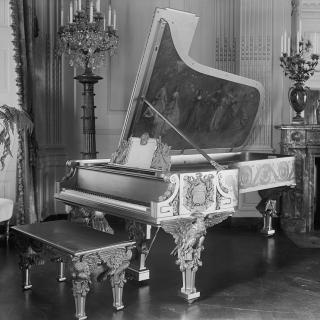
In 1903 and 1938, Steinway & Sons gifted their 100,000th and 300,000th custom, art-case grand pianos to the White House. The pianos, crafted with the White House East Room in-mind, were unlike any other Steinway pianos ever produced — they had extravagantly painted cases, gold leaf designs, and intricately carved wood.



![Sketch of the mythical fuan by Pearson Scott Foresman. [Source: Wikipedia]](/sites/default/files/styles/crop_320x320/public/2023-10/Goatman_Wikipedia_Faun_2_%28PSF%29.png?h=64a074ff&itok=C9Qh-PE1)



![Ben's Chili Bowl, 1980 (Photo Source: Library of Congress) Highsmith, Carol M, photographer. Ben's Chili Bowl, Washington, D.C. United States Washington D.C, None. [Between 1980 and 2006] Photograph. Retrieved from the Library of Congress, https://www.loc.gov/item/2011635251/. (Accessed December 04, 2017.)](/sites/default/files/styles/crop_320x320/public/17058v.jpg?itok=egZM-IR9 "Ben's Chili Bowl, 1980 (Photo Source: Library of Congress) Highsmith, Carol M, photographer. Ben's Chili Bowl, Washington, D.C. United States Washington D.C, None. [Between 1980 and 2006] Photograph. Retrieved from the Library of Congress, https://www.loc.gov/item/2011635251/. (Accessed December 04, 2017.)")