Welcome Home: Lilli Vincenz Launches the Gay Women’s Open House in Arlington
If a young woman in 1970s suburban Virginia felt herself attracted not to the boys in her classes but to the girls, she faced a difficult choice. The gay rights movement was gaining steam in cities like New York and San Francisco, but news and information traveled slowly to the suburbs through grassroots networks. Homosexuality was still considered a mental illness and a social aberration by many. Even if she did accept her sexuality, how could she express it? Taking a girl to prom or dating one openly might be unthinkable—if she ever even met another lesbian.
Lilli Vincenz knew those emotions intimately. The swirling feelings of isolation, grief, anxiety, and longing that accompanied her life as a closeted lesbian nearly drove her to suicide in her early twenties. Even when she accepted her attraction to other women, she was driven by one question: how she could “get more contact with gay girls” like herself.[1]
To combat this loneliness, to build community, and to strengthen the gay rights movement to which she dedicated her life, Vincenz chose to use her own home as a gathering place. The Gay Women’s Open House welcomed lesbian, bisexual, and questioning women to Vincenz’s property in Arlington for almost a decade. Of the many achievements in her long life of activism, the Open House was, for many of its attendees, one of the most impactful.
As one woman wrote in gratitude: “Your hospitality has made many people happy as well as helping many to find themselves.”[2]
Lilli Vincenz was born in Germany in 1937 and immigrated to the United States with her mother and sister in 1949. Vincenz was an intelligent, independent young woman, earning two bachelor's degrees and then a Masters in English from Columbia University. She started a Ph.D. program, but soon dropped out: she felt depressed, isolated, and unable to be herself. She had not met any other lesbians at Columbia. A psychiatrist recommended that she try to ignore her attraction to women.[3]
Around the same time, she had her first experience in a gay bar in Provincetown, Massachusetts. Mustering up the courage, she ventured into a tiny, dimly-lit bar behind a dingy restaurant, embarrassed at sitting alone. But the experience was also thrilling.
In her diary, Vincenz wrote giddily about flirting with other girls, exhilarated at the freedom and possibility she felt there.[4] Some of the women she met there had friends in the Army. The Armed Forces, they informed Vincenz, “is a hotbed of gay people.”[5] If she wasn’t headed back to Columbia, perhaps a career in the Army might be of interest.
Enlisting in 1962, Vincenz trained as a neuropsychiatric technician in the Women’s Army Corps. In 1963, she transferred to Walter Reed in D.C. To Vincenz, the Army was terrific: she enjoyed psychology and had even gotten a girlfriend. But just before she completed her training, a roommate denounced her for homosexuality and Vincenz was swiftly discharged from the WACs.
A psychiatrist evaluated her before she left, scrutinizing her sexuality. When he found out that she had worked in the psychiatric ward, he asked Vincenz: “Did it give you a kick to be with people who are sicker than you?”[6]
Vincenz wasn’t angry at being dismissed. Instead, she felt it gave her freedom to express herself authentically and find her community: once her roommate had outed her as a lesbian, “I didn’t have to hide anymore.”[7] She contacted the Mattachine Society of Washington, an early semi-radical gay rights organization founded by Frank Kameny. The MSW rejected the notion of homosexuality as a mental illness and Kameny believed that anti-gay prejudice had no basis in rational thought.[8] Unlike other organizations, the Mattachines in D.C. relied on picketing, literature, and civil disobedience to gain public support rather than persuading opponents.
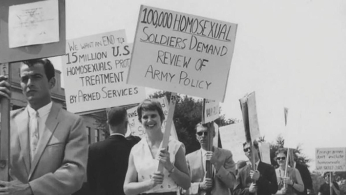
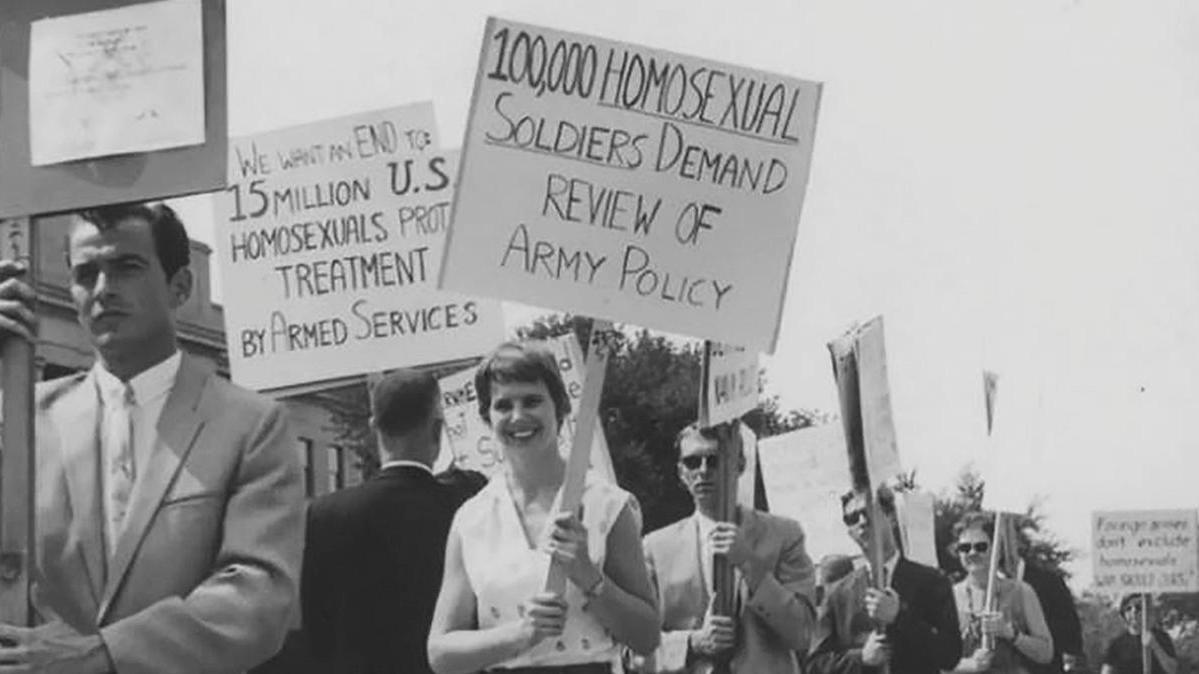
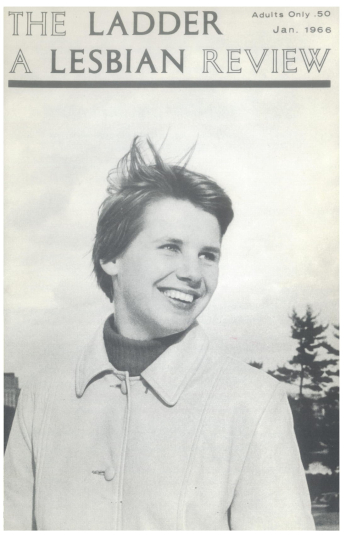
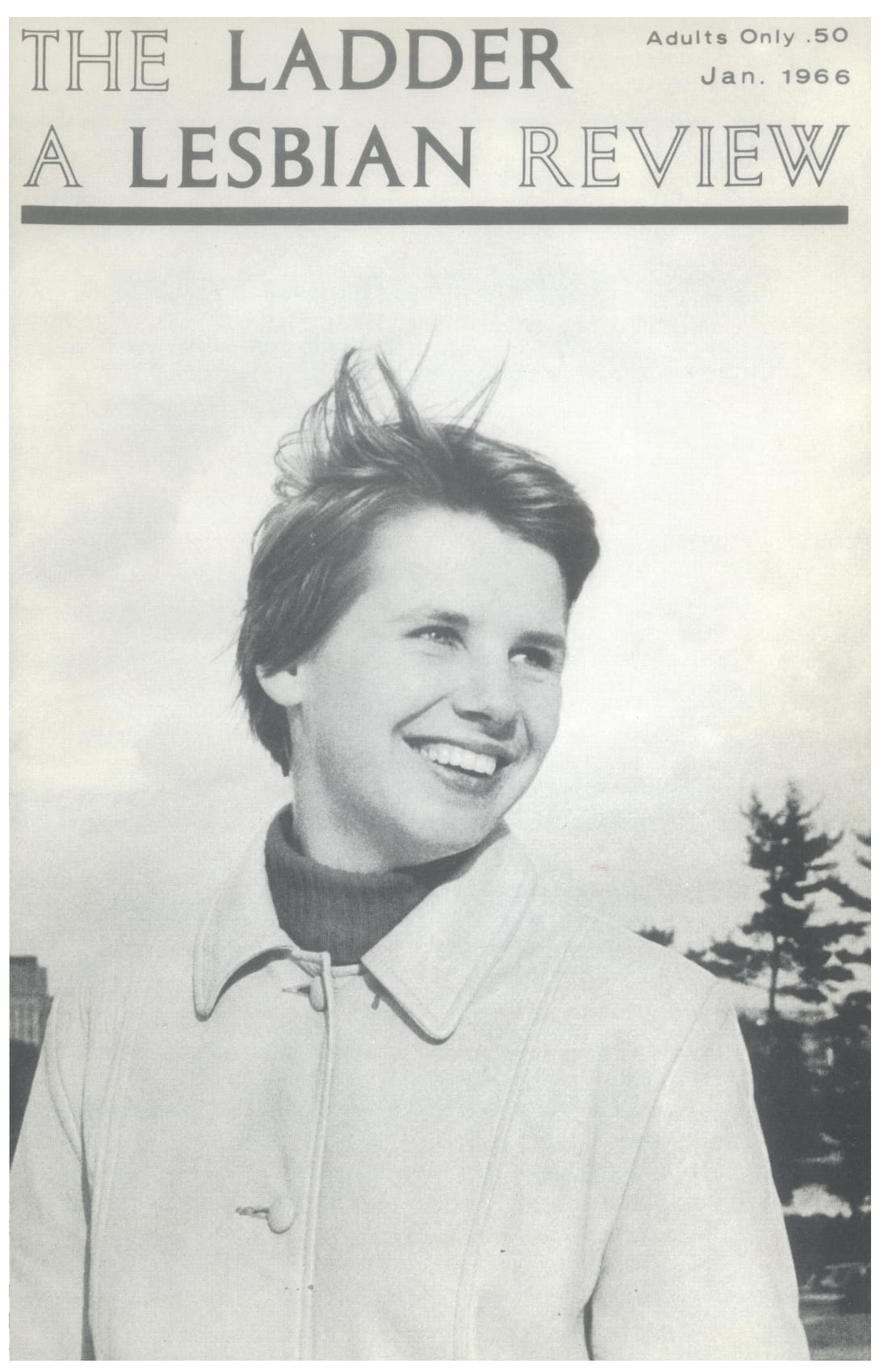
Vincenz became one of the first lesbian members of the MSW, beginning a long and prolific advocacy career. Kameny, who could become a close friend, asked her to act as the organization’s secretary and to edit its monthly magazine, The Homosexual Citizen.[9] She became one of the first open lesbians to picket in front of the White House and helped to launch Frank Kameny’s Congressional campaign. Vincenz co-founded the Gay Blade newspaper and stayed in touch with other lesbian writers: Barbara Gittings, editor of lesbian magazine The Ladder, convinced Vincenz to pose for its cover photo.[10] It was the first time a cover model had shown her face, and Lilli’s was smiling and proud.
In 1971, she appeared before the American Psychiatric Association to give personal testimony against the medicalization of homosexuality, which was still classified as a mental illness. That same year, she appeared on The David Susskind Show to debate stereotypes about gay people, becoming one of the first out lesbians on TV. The same week, a middle-aged woman stopped Vincenz in the grocery store and thanked her for appearing on television.
“You made me realize,” she said. “That gay people love each other just the way that Arnold and I do.”[11]
In 1971, Vincenz inaugurated one of her greatest contributions to the D.C. lesbian community: the Gay Women’s Open House, held at her home in Arlington. Recalling the isolation she had felt as a young, closeted lesbian, she wanted to provide a safe place for women to meet for companionship, solidarity, and entertainment. All lesbian, bisexual, and questioning women were invited to attend. Many visitors were D.C. residents, but the Open House also drew women all the way from Baltimore, Annapolis, Northern Virginia, and West Virginia. Even the Furies dropped in from time to time.[12]
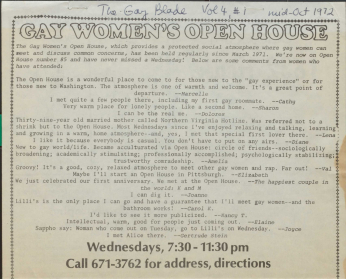
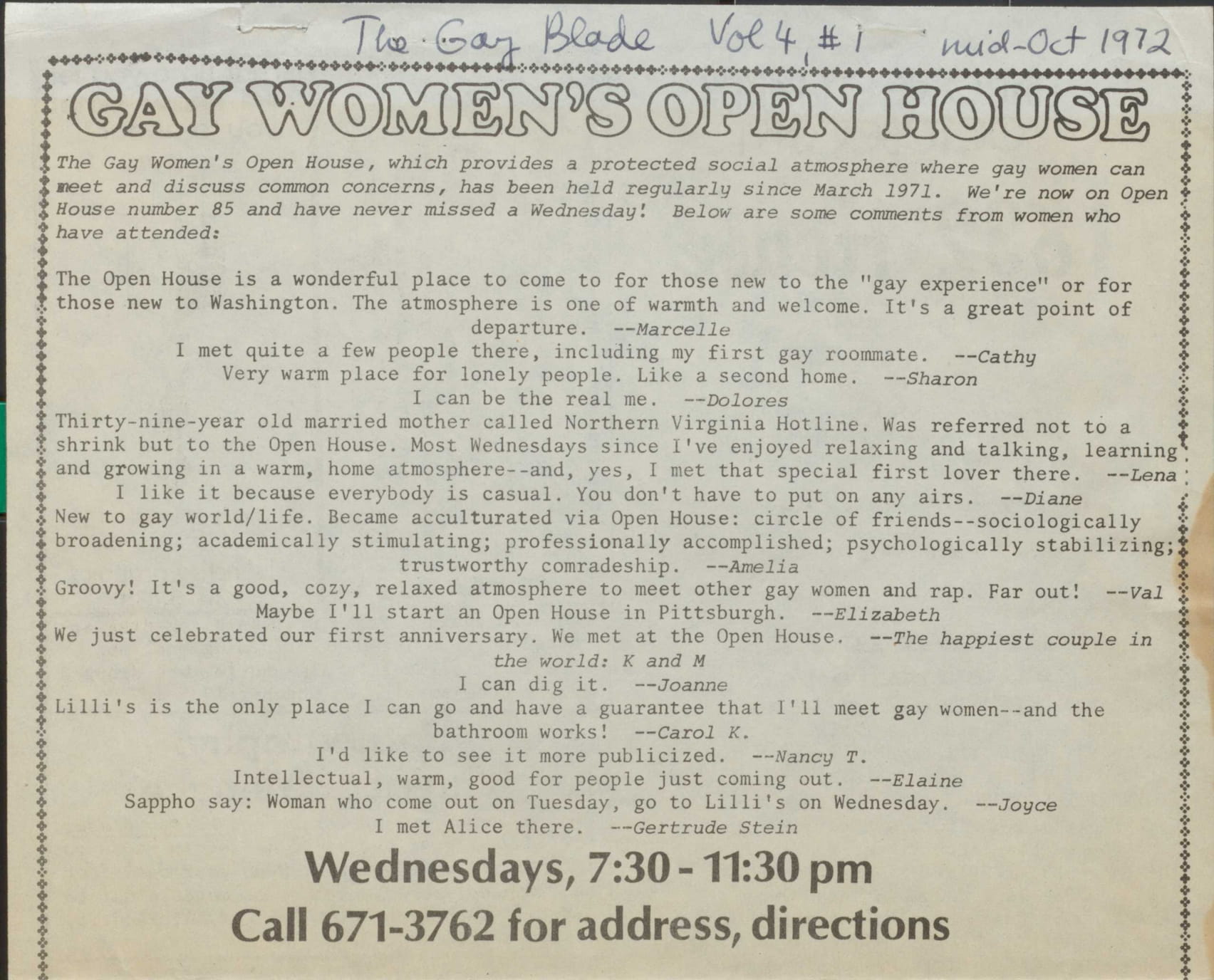
Vincenz always provided her guests with snacks and refreshments bought with donations made the week before. The Open House was not an official salon or debate forum, though Vincenz provided sample topics for discussion, including coming out, spirituality, androgyny, fantasies, falling in love, culture, sexism, and gratitude.[13] She also collected phone numbers to connect women with similar experiences. Many visitors were closeted wives and mothers who found great comfort in speaking with other women in their situation.[14]
The Open House was immensely popular because it offered an “alternative” to the gay bars in D.C., where the atmosphere could be “friendly, not cruisy.”[15] Gay bars often catered to men and could be intimidating or inaccessible for women who were exploring or had newly accepted their sexuality. Lilli considered them a “miserable” experience.[16] At her house, the bar for entry was nil: “Whether you are a lesbian under twenty-one or over fifty, whether you are radical or reactionary, a drop-out or a professional, a daughter or mother, single or in a gay or straight marriage, you are welcome,” a flyer for the event explained.[17]
The Open House could be a life-changing experience for the women who attended, and many wrote candid notes of gratitude to Vincenz. Women thanked her for helping them to come out, to accept themselves, to alleviate feelings of isolation and despair, and for providing one of the only places where they could openly be themselves.
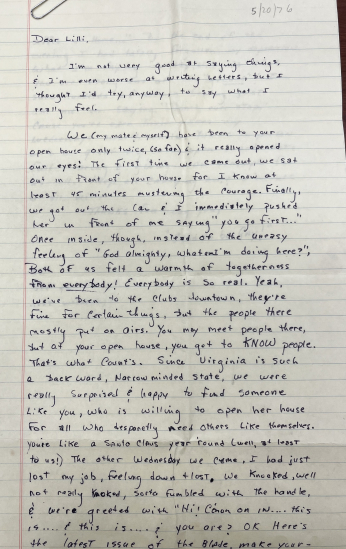
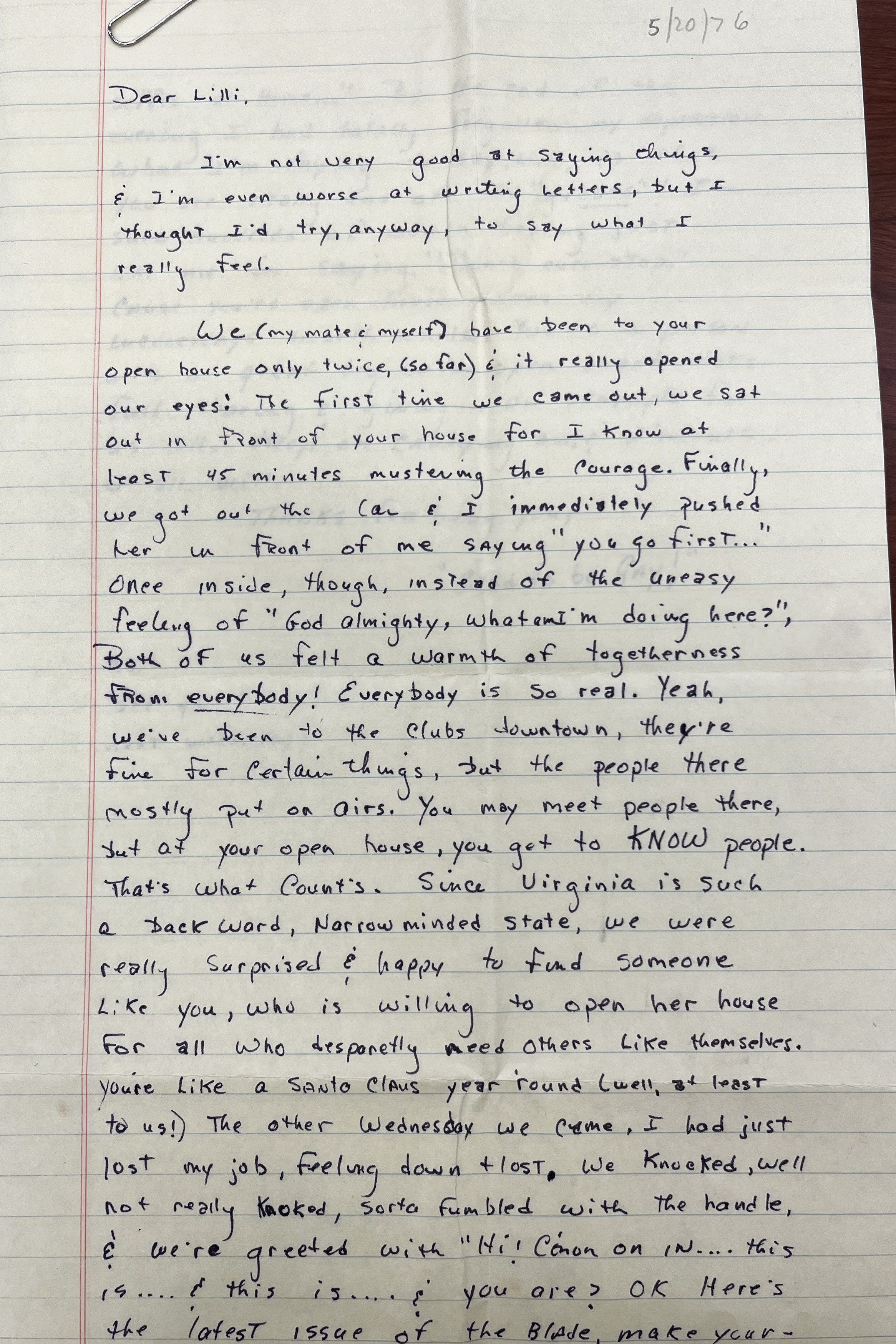
In 1976, one regular attendee wrote: “For all who desperately need others like themselves, you’re like a Santa Claus year ‘round… You’re [sic] open house makes my Wednesdays worthwhile.” Another said that the Open House “has given me a new outlook on life.”[18]
Partly because attendance grew too numerous to manage week after week, Vincenz ended her Open House in 1979, but continued to be an active part of the gay rights movement in D.C. After earning her masters in psychology, she started a private psychiatry practice to support queer women.[19] In the 1980s, she expanded her practice to include gay men affected by the AIDS crisis.
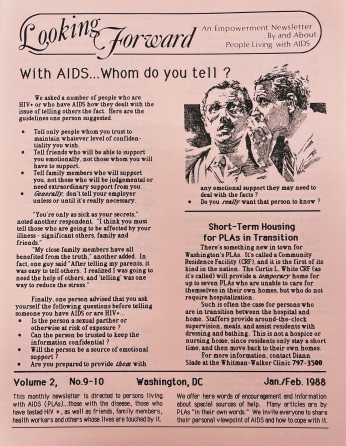
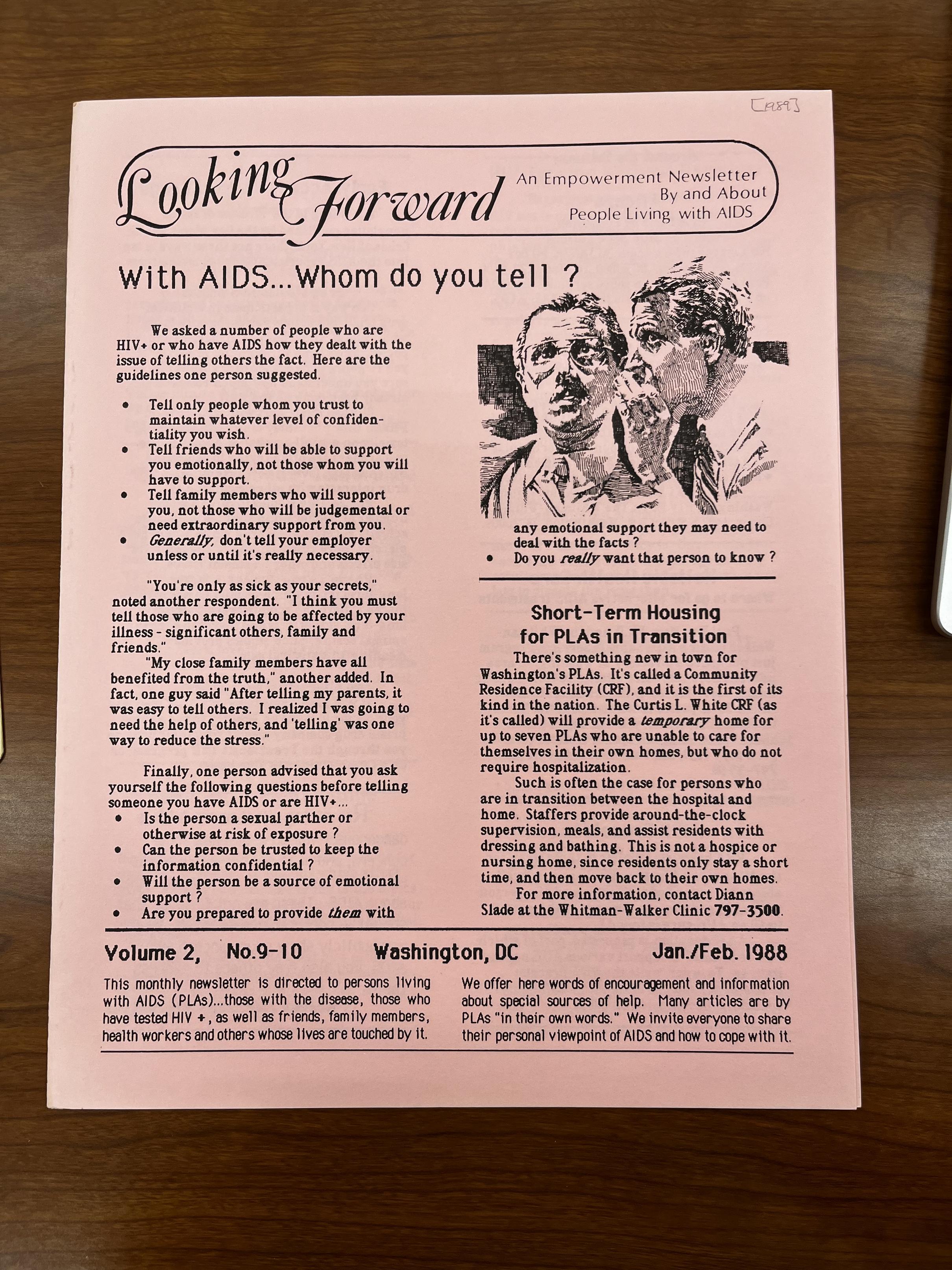
With her partner, Nancy Ruth Davis, she started the Empowerment Group for People Living with AIDS: an “ongoing, semi-structured counseling group” to “combat depression, isolation, boredom, and hopelessness” through emotional and physical healing.[20] They published a monthly newsletter about navigating an AIDS diagnosis, including advice on telling friends and family, community resources, and testimonies from people living with the disease. Vincenz interviewed every potential member and kept obituaries of those who died.
In the 1990s, she and Nancy opened another group, the Community for Creative Self-Development. This “learning community” was open to “gay women and men and all gay friendly people” in the Northern Virginia area.[21] The Community held meetings, annual conferences, retreats, and cultural outings, and organized educational courses and speaking events, offering another safe and productive space for queer people and allies to enjoy each other’s company.
Vincenz also left a legacy as a filmmaker. In 1968 and 1970, she filmed, edited, and published two short documentaries. The Second Largest Minority documented a July 4, 1968 picket in Philadelphia against job discrimination and the denial of rights to gay workers. Sharply-attired men and women in professional skirts marched in single file with neatly lettered signs expressing their discontent. Lilli recalled that Kameny imposed a “dress code” because to be taken seriously, “we had to look normal; we had to be rational; we had to be intelligent.”[22]
The second film, Gay and Proud, captured the first Christopher Street Liberation Day Parade in 1970. Hot off the heels of Stonewall, open emotion, noise, and lively disorder had replaced the professional moderation of 1968. Protesters marched in clumps or stopped to dance in the street. They were younger, and louder, and their messages had changed. Signs read, Say It Loud, Say It Proud! and I’m a Lesbian, and I’m Beautiful! and marchers chanted, “two, four, six, eight—gay is just as good as straight!”[23]
Together, these films captured an “explosion of cultural change” in the gay rights movement.[24] In only two years, its aesthetics and attitude had transformed: it was more spirited, more rebellious, more joyful, angrier, and above all, less concerned with fitting into norms. The American gay rights movement had changed, and it had incorporated a new and electric element: pride.
Lilli Vincenz spent her life helping queer Americans take pride in their identities. She was fond of reminding her opponents that homosexuality was not an illness, choice, lifestyle, or counterculture, but “primarily a way of loving.”[25] Her long career as an organizer and activist was focused on creating spaces in D.C. where people could feel and express love: for themselves, their family, friends, neighbors, and romantic partners, whoever they happened to be.
You can watch Lilli Vincenz’s documentary films via the Library of Congress:
- The Second Largest Minority, 1968 (7 minutes)
- Gay and Proud, 1970 (12 minutes)
![Sketch of the mythical fuan by Pearson Scott Foresman. [Source: Wikipedia]](/sites/default/files/styles/crop_320x320/public/2023-10/Goatman_Wikipedia_Faun_2_%28PSF%29.png?h=64a074ff&itok=C9Qh-PE1)