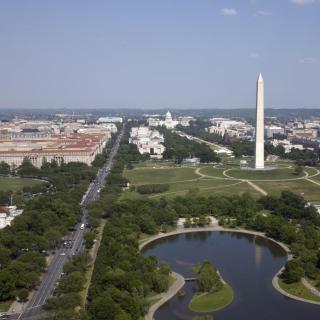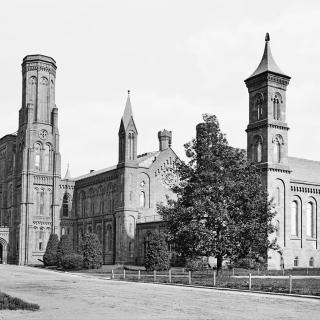


Not surprisingly, our nation’s capital has undergone some pretty radical changes since its beginning. One hundred and sixty years ago, the landscape of the National Mall and surrounding streets looked vastly different than it does today. We’re talking an armory, one museum, the Washington Monument, and not much else.
You’d better believe there have been "mean girls" since the beginning of time, or at least the early 1800s. Rigid social structures dictated the behavior of Jacksonian high society; it was the height of rudeness, for instance, if a lady did not return your call. However, in a social war that engulfed the beginning of Andrew Jackson’s presidency, society’s rules were discarded and the national government ground to a halt all for one woman: the beautiful and intelligent Margaret “Peggy” O’Neill.
Apparently Hungerford’s Tavern in Rockville, Maryland was the place to be. Constructed around 1750, it was one of America’s first real taverns and hosted a number of big shots including George Washington, Benjamin Franklin, Thomas Jefferson, and Patrick Henry. In Rockville, it was a favorite watering hole for news, entertainment, business… and to fan the flames of Revolution.
Colonel Ninian Beall, a towering Scottish settler who helped found Georgetown and lived to 92, earned a bronze‑plated memorial in 1910—complete with a hidden surprise. The stone carver was an aviation enthusiast who tucked newspaper clippings and a biplane photo into a compartment inside memorial, turning a colonial tribute into a quirky time capsule.
On the evening of March 5, 1854, nine men associated with the Know-Nothing party snuck up to the base of the Washington Monument and made off with a rather hefty hunk of stone. The men carried the stone to a boat waiting on the tidal basin, smashed it into pieces and dumped it in the middle of the Potomac. But why?
In the late 1890s, many women in the capital city began to push for a more open society, pursuing higher education, living alone, and managing their own affairs. This was the dawn of the Bachelor Girl age, which shocked and appalled many in the Washington press.
It’s a casual Sunday in April 1934 and you’re looking for something to do. How about a hike in the great outdoors? Lucky for you, there’s a new hiking club in town — the Wanderbirds — and they are preparing for their very first hike!
No doubt you are familiar with D.C.’s most prominent tributes to history -- the Washington Monument, the Lincoln Memorial, possibly even that unique sculpture of Einstein lounging on Constitution Avenue. But have you ever heard of the Zero Milestone?
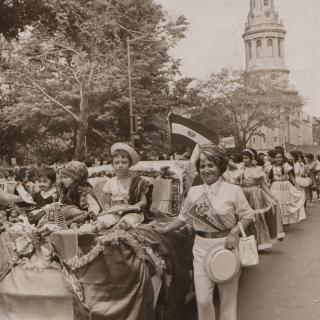
In the 1850s, Georgetown’s Fourth of July celebration was a neighborhood pageant of marching Sunday schools, bands, banners, barrels of lemonade, and speeches at Parrott’s Woods, now the site of Oak Hill Cemetery.
Women’s fashion is a complicated subject, but one doesn’t usually think of it as deadly. However, the fatal dance between health and beauty was a reality for Washington women wearing corsets in the 19th century.
Even Washington D.C. couldn’t hold Harry Houdini, the original handcuff king. On New Years Day in 1906, the infamous Houdini broke out of what was said to be the strongest and toughest jail in the city.
Washington, D.C., has had its fair share of scandals, political pandemonium, and secret trysts over the years. But it’s not every day that a Congressman commits cold-blooded murder in broad daylight on a city street.