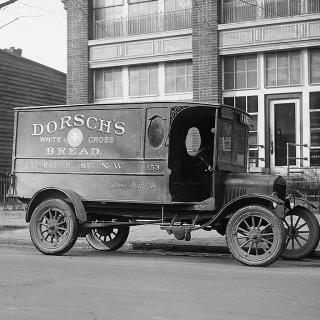
The industrial revolution was reshaping the United States in the 19th and early 20th centuries, as the country shifted from a pure agrarian structure, to a more industrial one. While many major American cities of the early 20th century were home to bustling factories and mills pumping smoke into the air, Washington’s largest processing industry filled the air with a different smell—fresh baking bread. In the same neighborhood as the former Griffith Stadium in Shaw, family-owned bakeries lined the streets. Among the most prominent of these bakeries were Dorsch’s White Cross Bakery, Holzbeierlein Bakery, and Corby Baking Company, which were responsible for producing almost all of the bread, cake, and pastry products sold in the Washington area, consequently making them all household names in D.C.
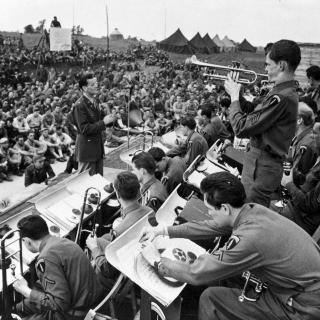
On Nov. 13, 1945, the National Press Club hosted a dinner honoring President Harry Truman at Hotel Statler. The 1,000 person guest list featured a virtual who’s who of Washington’s political elite, but more than anything, attendees looked forward to a performance by Glenn Miller’s famous Army Air Force Band. While festive, the evening was also bittersweet, for the band was without its leader. Nearly a year earlier, Major Glenn Miller, famous bandleader and trombonist, had gone missing over the English Channel, while traveling from England to France to give concerts to the troops liberating Europe.
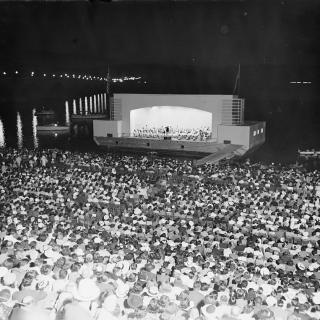
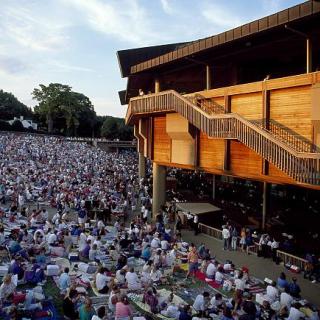
On the evening of July 14, 1935, just behind the Lincoln Memorial, on the steps of the Watergate Amphitheatre, 10,000 Washingtonians, dressed in flannel and gingham, sat on blankets and newspapers. Out on the water, hundreds of others dressed in bathing suits floated in canoes, eager to experience Washington’s newest summertime tradition: floating concerts by the National Symphony Orchestra. The NSO was taking to the water, inaugurating a new “Sunset Symphony” series, wherein the orchestra would offer summertime performances on a 75 foot concert barge bobbing in the Potomac River.
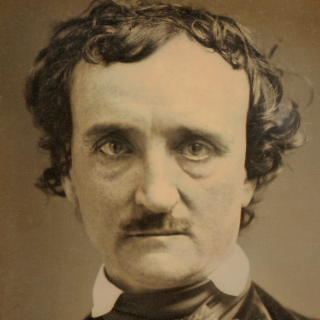
The celebrated, yet ever tormented, writer Edgar Allan Poe, famously spent much of his life living in Baltimore and Richmond, but he surprisingly spent very little time in D.C. despite residing in such close proximity. He did however have one…interesting encounter in Washington. Frequent transitions through different literary critic jobs left him in a constant state of mental and financial instability; this led Poe to determine that he needed to find a job that could provide him with more financial security. His friend Frederick William Thomas was friends with President John Tyler's son, Robert, and offered to help get him a government job. Eventually, in 1843, Poe traveled down to Washington from his home in Philadelphia to meet with the President. The true account of how Poe conducted himself upon arriving is still contested today.
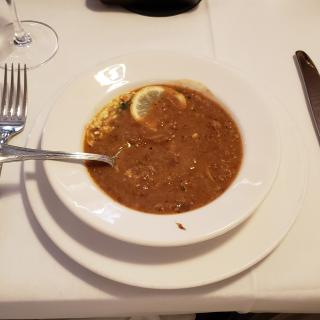
Before the days of Half Smokes and Jumbo Slices, D.C.’s collective stomach rumbled for a different delicacy: diamondback terrapin. The native turtle had long fed residents of the Chesapeake but by the 1830s the turtle had become one of the region’s most coveted foodstuffs and by the end of the 19th century, swanky eateries from New York to California featured turtle soup on their menus. While turtles from all over the U.S. were used to prepare this famous dish, the Chesapeake Diamondback was undoubtedly the turtle of choice.
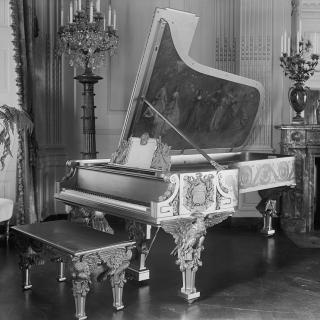
In 1903 and 1938, Steinway & Sons gifted their 100,000th and 300,000th custom, art-case grand pianos to the White House. The pianos, crafted with the White House East Room in-mind, were unlike any other Steinway pianos ever produced — they had extravagantly painted cases, gold leaf designs, and intricately carved wood. The pianos quickly became beacons for art and culture in the East Room and Entrance Hall of the White House where the second one still resides today. Theodore, Edith, and Franklin Roosevelt utilized and dedicated these two Steinway pianos to help establish the White House as a hub for music in Washington moving forward into the 20th Century.
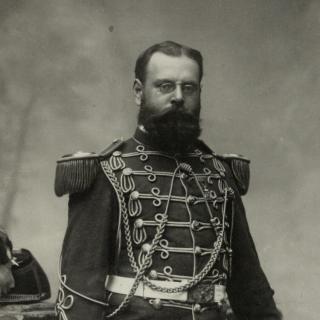
In the summer of 1892 Washingtonians had their hearts broken. After 12 years of conducting the United States Marine Band, John Philip Sousa, D.C. native and beloved conductor, submitted his resignation to the U.S. Marine Corps. He was leaving for Chicago, where he accepted an offer to serve as musical director of a new military-style civilian band. The public would not let their beloved Sousa go easy, and arranged a farewell testimonial concert where he could exhibit his grand conducting skills for an eager audience one more time. This concert served as the first of two farewell concerts for Sousa with the second taking place the very next day on the White House Lawn.
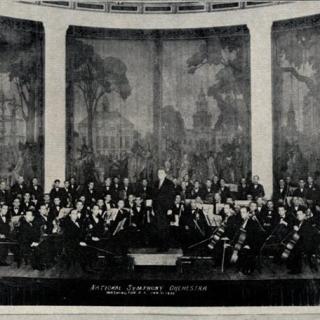
At 4:45 p.m. on January 31, 1930 the “new and shaky ensemble known tentatively as the National Symphony Orchestra of Washington D.C.” took the stage of the recently finished DAR Constitution Hall at eighteenth and C streets northwest. Conductor Rudolf Schueller and the musicians were welcomed into the hall by vigorous applause from an audience of 2,000 music-loving Washingtonians who eagerly awaited the newly established orchestra’s first notes. Arriving at this moment of glory did not happen easily, or quickly for that matter. While Washington is typically considered a capital of arts and culture today, this was definitely not the case in the early 1900s.
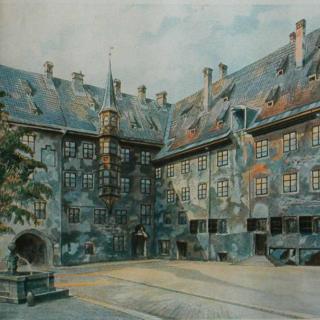
In 1956, the Woodward & Lothrop department store in Washington DC, located at 11th and F St NW, hosted a traveling exhibit purporting to showcase the “American Dream.” Woodward & Lothrop, or “Woody’s” as it was affectionately called, was a staple in the city for over one hundred years, from the late 1800s to 1995, when it merged with another company. During the "Era of Department Stores," a period lasting from the '30s to the '70s when department stores were the main mode of shopping for the American family, Woodward & Lothrop was the King of DC. This is probably why the store felt entirely comfortable hosting the “American Dream” exhibit, and the exhibit’s main draw: four watercolors painted between 1917 and 1919 by Adolf Hitler.
On June 8, 1918, Washingtonians looked to the sky hoping to see… well… something. But, many weren’t quite sure exactly what. As the Evening Star noted:
“There was a great craning of necks on the streets. Many a citizen who had read about the eclipse and forgotten about it, wanted to know where the aeroplane was…. One woman called up The Star and wanted to know whether the Marine Band ‘is playing on the eclipse.’ A reporter carefully explained that the Marine Band sometimes played on the Ellipse.”
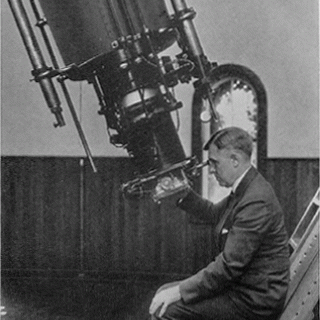
For scientists at the U.S. Naval Observatory on Massachusetts Avenue, however, there was no confusion. The day marked an extraordinary astronomical event -- a transcontinental total eclipse -- and they pulled out all the stops to document it.
For the past 18 years, the United States Holocaust Memorial Museum has hosted the First Person program each summer. These programs are open to the public, and allow musuem visitors to listen to personal stories of Holocaust survivors, and to engage with them.
Those who travelled into the District in the early part of May could enjoy a rock concert, good food, and plenty of protesting. In May 1971, the culmination of months of anti-Vietnam protesting took hold of D.C., when thousands of young Americans attempted to block traffic, execute sit-ins, and make their voices heard.


![Sketch of the mythical fuan by Pearson Scott Foresman. [Source: Wikipedia]](/sites/default/files/styles/crop_320x320/public/2023-10/Goatman_Wikipedia_Faun_2_%28PSF%29.png?h=64a074ff&itok=C9Qh-PE1)